
Pierre Bossan Architect Biography: Lyon's Visionary
Explore the Pierre Bossan architect biography. Learn about his impact on Lyon and the Notre-Dame de Fourvière architectural style in this 2025 guide.
On this page
The Pierre Bossan architect biography offers a fascinating look into the life of a visionary creator. He was a man who successfully blended spiritual devotion with technical excellence in building design. His impact on the city of Lyon is visible from almost every major viewpoint today. In this comprehensive guide, we explore the history and legacy of this remarkable French architect. Born in 1814, Bossan grew up during a time of significant cultural and social change. He developed a deep interest in religious structures that would eventually define his entire professional career. The city of Lyon served as his primary canvas for many of his most ambitious projects. Understanding his life requires a look at his education and his early architectural experiments.
His work remains a cornerstone of the city's architectural identity in the current year 2025. Architects from around the world travel to Lyon to study his innovative use of materials. His legacy is preserved through careful restoration projects funded by the local government and private donors. The 2025 tourist season expects a record number of visitors to his most famous sites. Pierre Bossan was a highly influential architect who transformed the religious landscape of nineteenth-century France. His designs were known for their complexity, beauty, and deep historical and spiritual meaning. Exploring his life helps us appreciate the grand buildings that define the skyline of Lyon today.
Early Life and Architectural Training
Pierre Bossan was born in 1814 within the historic and vibrant city of Lyon, France. He spent his most formative years exploring the winding and narrow streets of his beloved home city. This early connection to the local urban environment influenced his later world-renowned architectural masterpieces. His supportive family recognized his artistic talent and encouraged his decision to study formal building design. He eventually moved to Paris to seek higher education at the prestigious École des Beaux-Arts.
During his time in Paris, he studied under the guidance of the famous architect Henri Labrouste. Labrouste taught him the importance of structural integrity and the functional use of modern materials. Bossan absorbed these lessons while also developing a personal interest in historical and religious styles. He spent many hours sketching the grand cathedrals and classical monuments found throughout the French capital. This period of intense study helped him develop a unique and sophisticated design language.
After completing his studies, Bossan returned to Lyon to begin his professional journey as an architect. He initially worked on smaller projects, including private residences and minor commercial buildings in the city center. These early works allowed him to experiment with different forms and decorative elements on a local scale. He quickly gained a reputation for his attention to detail and his creative approach to design. His early success paved the way for the larger commissions that would soon follow.
In the mid-nineteenth century, Bossan won the position of architect for the cathedral of Saint-Jean in Lyon. This role gave him the opportunity to work on one of the most significant religious sites in France. He focused on restoring the ancient structure while adding his own subtle artistic touches to the building. This experience solidified his status as a leading expert in religious and historical architecture within the region. It also prepared him for the most ambitious project of his entire professional life.
His journey from a young student in Paris to a respected architect in Lyon was truly remarkable. He faced many challenges, including shifting artistic trends and the high expectations of the local church authorities. However, his dedication to his craft and his strong personal vision never wavered during these early years. Each project he completed added to his growing expertise and his influence on the local community. By the time he reached maturity, he was ready to change the skyline of Lyon forever.
Defining the Notre-Dame de Fourvière Style
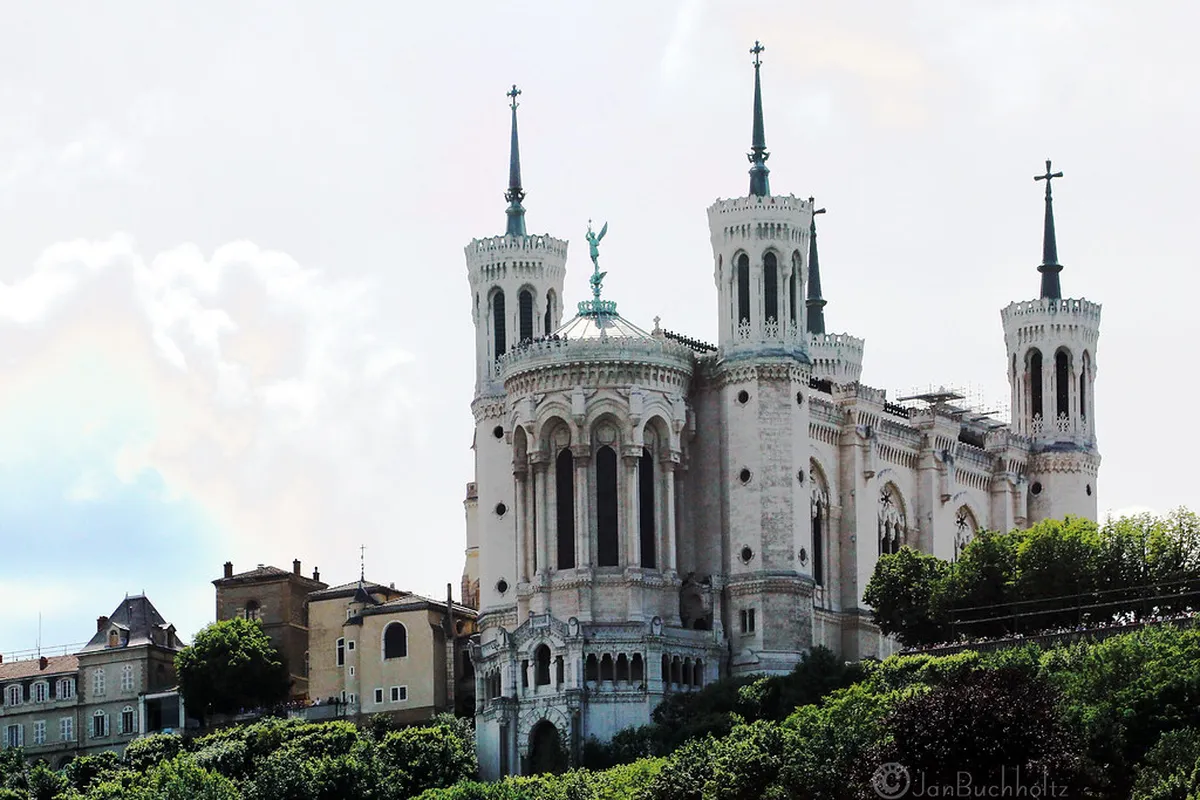
The Notre-Dame de Fourvière architectural style represents a bold departure from traditional Gothic designs of the era. Bossan integrated elements from Byzantine and Romanesque traditions to create something entirely original and deeply moving. He believed that a church should resemble a fortress to protect the faith of the people. This vision resulted in the massive towers and heavy walls seen on the Fourvière hill today. Researchers often study the Notre-Dame de Fourvière architectural style to understand nineteenth-century religious revivals.
The style is characterized by its heavy use of stone and intricate, detailed carvings on the exterior walls. Bossan chose these materials to convey a sense of permanence and eternal strength to all who visited. The four main towers of the basilica are iconic symbols that can be seen from miles away. Each tower was designed to represent a different cardinal virtue in Christian theology and tradition. This layers of meaning added a spiritual depth that resonated with the local population of Lyon.
Inside the basilica, the style shifts from a fortress-like exterior to a lavish and golden sanctuary. Bossan used light and color to create a celestial atmosphere that felt separate from the world outside. The use of gold leaf, marble, and colorful mosaics creates a breathtaking experience for every modern visitor. In 2025, the interior remains one of the most visited and photographed locations in all of France. The contrast between the exterior and interior is a hallmark of his unique architectural philosophy.
Many critics at the time were surprised by his decision to move away from pure Gothic Revival styles. However, Bossan felt that the Byzantine influence better reflected the early roots of the Christian church. He spent years researching the designs of churches in the East to find inspiration for his work. This global perspective allowed him to create a building that felt both ancient and modern at once. His work at Fourvière remains the ultimate expression of this eclectic and powerful architectural vision.
The success of this style influenced many other religious buildings constructed during the late nineteenth century in Europe. Architects looked to Bossan as a leader who was not afraid to break established artistic rules. He proved that religious architecture could be innovative while still respecting the traditions of the past centuries. Today, his work is celebrated for its courage, its beauty, and its lasting impact on the city. The basilica stands as a monument to his genius and his deep love for his hometown.
The Interior Mosaics and Artistic Vision
The interior of the basilica showcases the brilliant use of light and expansive open spaces designed by Bossan. He worked closely with various craftsmen to ensure every detail met his high artistic standards and goals. Visitors in 2025 can still admire the Fourvière basilica interior mosaic art throughout the nave. These mosaics tell stories of faith while enhancing the overall structural beauty of the building. The colors remain vibrant even after more than a century of exposure to the elements.
Bossan wanted the mosaics to serve as a visual bible for those who could not read the text. Every scene was carefully planned to fit within the overall architectural flow of the massive interior walls. The gold backgrounds reflect the natural light coming through the stained glass windows during the day. This creates a shimmering effect that makes the entire space feel alive and filled with holy energy. The precision required to install these millions of tiny tiles was truly an incredible technical feat.
The themes of the mosaics focus on the life of the Virgin Mary and the history of Lyon. Bossan felt it was important to connect the local history of the city with the broader religious narrative. This connection helped the people of Lyon feel a personal ownership of the grand basilica on the hill. Artists from across Europe were invited to contribute their skills to this massive and complex decorative project. The result is a harmonious blend of different artistic hands under the unified vision of one man.
In 2025, restoration teams work tirelessly to preserve these delicate works of art for future generations to enjoy. They use modern technology to clean the tiles and repair any damage caused by time or humidity levels. Bossan would likely be pleased to see his artistic vision being maintained with such care and dedication. The mosaics are not just decorations; they are an integral part of the building's spiritual and structural identity. They represent the peak of nineteenth-century decorative arts in the context of religious building design.
Walking through the basilica today offers a sensory experience that is difficult to find anywhere else in France. The combination of grand architecture and intricate mosaic work creates a sense of awe and quiet wonder. Bossan understood that beauty could be a path to the divine for many people who visited the church. His commitment to artistic excellence is visible in every corner of the sanctuary he built in Lyon. This focus on beauty has made the basilica a world-famous destination for art lovers and pilgrims alike.
Architectural Philosophy and Methods
Bossan focused on the harmony between the natural landscape and the built environment during his entire career. He used local stone to ensure the buildings felt connected to the earth and the regional history. This approach created a sense of permanence and strength in his religious designs across the country of France. He often spent weeks studying the site of a building before even drawing the first architectural plans. This careful preparation ensured that the final structure would perfectly complement its specific and unique surroundings.
He believed that the role of an architect was to be a master of all building trades. Bossan was known for his hands-on approach and his constant presence on the actual construction sites of his projects. He would often speak directly with stone masons and carpenters to discuss the fine details of their work. This level of involvement was unusual for architects of his status during the nineteenth century in Europe. However, it was this dedication that ensured the high quality of his finished buildings and monuments.
His philosophy also included a strong belief in the power of symbolism within the context of architectural design. Every window, tower, and carving had a specific meaning that was intended to be understood by the viewer. He used geometry and proportion to create a sense of balance and order within his complex and grand designs. This mathematical precision provided a solid foundation for the more decorative and artistic elements of his buildings. He was truly a master of both the technical and the aesthetic aspects of his profession.
In 2025, many architecture students study his methods to learn about the integration of art and structural engineering. He showed that a building could be both a functional space and a powerful work of symbolic art. His use of innovative iron supports allowed for larger windows and more open spaces within the stone walls. This blend of traditional masonry and modern engineering was ahead of its time in many significant ways. He was a pioneer who helped bridge the gap between ancient methods and the industrial age.
Ultimately, Bossan sought to create buildings that would stand for centuries and inspire many future generations of people. He was not interested in temporary fashions or passing trends in the world of art and design. His focus was on creating timeless structures that reflected the eternal truths he found in his own faith. This long-term perspective is why his buildings remain so relevant and well-preserved in the current year. His work is a testament to the enduring power of vision combined with hard work and skill.
Impact on Lyon's Urban Identity
The influence of Pierre Bossan on the city of Lyon cannot be overstated by any modern historian today. His basilica on the hill of Fourvière has become the primary symbol of the city for the world. It is the first thing people see when they arrive in Lyon by train or by road. The building acts as a guardian overlooking the streets and the rivers that flow through the heart. This placement was a deliberate choice by Bossan to ensure the church remained central to city life.
Beyond the basilica, his work influenced the general aesthetic of the city during the nineteenth-century expansion period. Other architects began to incorporate his ideas about stone choice and decorative motifs into their own local projects. A Lyon architecture walking tour provides the perfect opportunity to see his work up close. These tours often highlight how his designs integrated with the existing Roman and Renaissance history of the city. He helped create a cohesive urban identity that celebrates both the old and the relatively new.
The city of Lyon has honored his memory by naming streets and public spaces after him in recent years. His home and his studios have become points of interest for those interested in the history of design. Local museums often host exhibitions that explore different aspects of his life and his many artistic achievements. The community takes great pride in the fact that such a world-class talent was a native son. His legacy is woven into the daily lives of the people who live and work there.
In 2025, the city continues to benefit from the tourism that his buildings attract from all over the globe. The economic impact of his work is significant for the local hospitality and tourism sectors of the economy. Shops, restaurants, and hotels near his major sites thrive because of the constant flow of international visitors. Bossan probably did not imagine the economic scale of his influence when he was sketching his initial designs. However, his commitment to excellence created a lasting asset for the entire community of Lyon, France.
The preservation of his work is a top priority for the municipal government and the local church authorities. They recognize that his buildings are part of the cultural heritage of the entire nation of France. Large sums of money are invested every decade to ensure the stone and the mosaics remain in good condition. This ongoing commitment ensures that his vision will continue to be shared with many future generations to come. Pierre Bossan truly transformed his city into a living museum of architectural beauty and spiritual power.
Visiting the Work of Bossan in 2025
Visiting the works of Pierre Bossan in 2025 is an easy and rewarding experience for any traveler today. The Basilica of Notre-Dame de Fourvière is accessible by a charming funicular railway from the historic Vieux Lyon district. This short journey offers great views of the city as you climb the steep hill to the site. Once you reach the top, you are greeted by the massive and impressive facade of his masterpiece. The site is open to the public for most of the day throughout the entire year.
It is recommended to visit early in the morning to avoid the largest crowds of the busy tourist season. This allows you to appreciate the silence and the spiritual atmosphere of the interior space more fully. You should also take the time to explore the exterior terraces that surround the grand building on all sides. From these points, you can see the intricate stone carvings that Bossan supervised with such careful and constant attention. The panoramic views of Lyon from the hill are also a highlight of any visit in 2025.
Several guided tours are available that focus specifically on the life and the architectural techniques of Pierre Bossan. These tours provide deep insights into the hidden symbols and the complex engineering used during the construction process. You can learn about the challenges the workers faced while building on such a steep and difficult slope. The guides also explain the meaning behind the various mosaics and sculptures found throughout the entire church site. These educational experiences add a lot of value to a standard visit for curious travelers.
The cost of entering the basilica is generally free, though donations for maintenance are always welcomed by the staff. Some special tours of the roof and the towers may require a small fee and a booking. These upper tours offer a unique perspective on the construction of the massive domes and the corner towers. You can see the craftsmanship of the stone up close while enjoying the highest views in the city. It is an experience that most visitors find to be well worth the small extra cost.
After visiting the basilica, you can explore the nearby gardens and the ancient Roman ruins located on the hill. Bossan purposefully designed the church to sit near these historic sites to connect with the deep past of Lyon. You can spend an entire afternoon walking through the area and enjoying the mix of different historical periods. The hill of Fourvière remains the spiritual and historical heart of the city thanks to his grand vision. A visit here is a journey through the mind of one of the greatest architects of France.
Frequently Asked Questions
What is the main focus of the Pierre Bossan architect biography?
His biography focuses on his transition from classical training to neo-Byzantine religious designs during the nineteenth century. It details his education in Paris and his ultimate return to transform the skyline of his home city. He is best known for combining technical skill with a deep sense of religious symbolism in all his buildings.
Why is the Notre-Dame de Fourvière architectural style so unique?
The style is unique because it blends Byzantine, Romanesque, and Gothic elements into a single cohesive structural design. Bossan created a building that looks like a fortress from the outside but reveals a golden sanctuary inside. This contrast was revolutionary at the time and remains a signature feature of his work in Lyon.
Where can tourists find the best examples of his work in 2025?
The best example is the Basilica of Notre-Dame de Fourvière which overlooks the entire city of Lyon from the hill. You can also find his influence in the restoration work he performed on the Saint-Jean Cathedral in the city center. Many visitors also travel to the town of Lalouvesc to see another of his significant religious projects.
What materials did he typically use in his grandest religious projects?
He preferred using local stone for the main structure to ensure the buildings felt connected to the French landscape. For the interiors, he used lavish materials like gold leaf, diverse marbles, and millions of colorful mosaic tiles. He also integrated modern iron supports to allow for larger and more ambitious structural designs within the buildings.
How did his time in Paris influence his early career in Lyon?
His time in Paris gave him access to the best architectural education in the world at the École des Beaux-Arts. He learned the importance of structural integrity and precision while studying under the famous master Henri Labrouste. This strong foundation allowed him to take on complex projects with confidence when he returned to his hometown.
Pierre Bossan was a true visionary who defined the religious landscape of France during the nineteenth century. His masterpiece in Lyon continues to inspire millions of visitors and pilgrims every single year in 2025. Exploring his work offers a unique glimpse into the soul of nineteenth-century architecture and religious devotion. We encourage you to visit the Fourvière hill and experience the power of his grand vision for yourself. His legacy as a master builder and a devoted artist is firmly secured in the history of Lyon.
Key Takeaways
- Understand the blend of Byzantine and Romanesque styles in his work.
- Recognize his role in shaping the iconic skyline of modern-day Lyon.
- Appreciate the deep spiritual symbolism integrated into all his structural designs.
- Learn how his education in Paris informed his innovative building techniques in France.
Related reads: architecturebycity.com, architecture in lyon, fourviere observatory tower views.