
Cryptoporticus Arles Engineering and History Guide
Explore the Cryptoporticus Arles engineering and history. Discover Roman architecture in Arles and technical underground designs in our 2025 guide. Visit now!
On this page
The Cryptoporticus Arles engineering and history reveals the incredible skill of ancient Roman builders. These underground galleries served as the hidden foundation for the city’s vast central forum. Built during the late first century BC, the tunnels remain remarkably intact for modern visitors. This site remains a cornerstone of Roman architecture in Arles today.
Understanding this structure requires looking beyond the visible ruins of the upper city level. The Roman engineers designed these tunnels to solve specific geological problems on the Arles hillside. They created a level platform for the massive public buildings and temples of the forum. This subterranean world offers a unique perspective on the city’s ancient urban planning.
Architectural Design of the Foundation
The primary purpose of the Cryptoporticus was to level the sloping ground of the city. Roman architects faced a significant slope toward the Rhône River on this specific hillside. They designed the galleries as a massive artificial platform to level the Forum area. This solution allowed for the construction of a perfectly flat public square above.
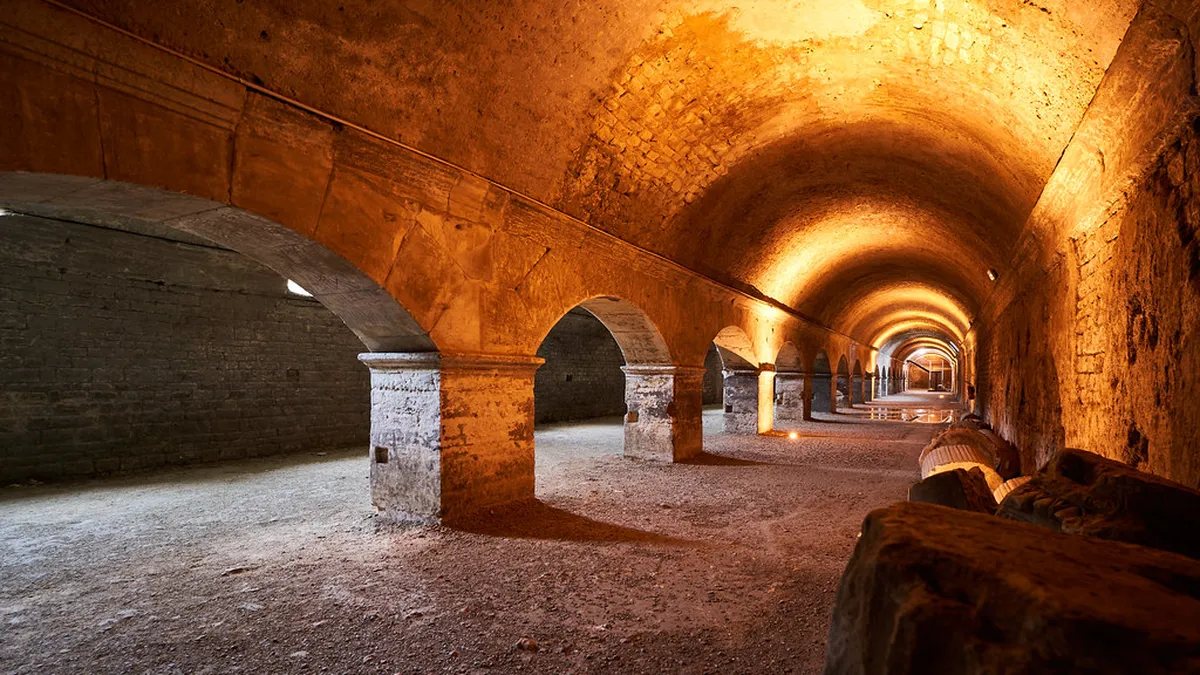
Engineers built three connected galleries forming a massive U-shaped structure deep in the earth. This massive base supported the heavy weight of the forum’s porticoes and public buildings. The Roman Forum in Arles required a stable and level base for its massive temples. Today, these galleries stand as a testament to the durability of ancient building methods.
The three galleries intersect at right angles to create a stable underground support system. Each gallery consists of two parallel vaults separated by a series of thick stone pillars. This double-vaulted design effectively doubles the surface area available for the structural load above. It represents a sophisticated approach to managing the stresses of heavy urban construction.
Structural stability was achieved through careful calculations of weight distribution across the underground vaults. The southern gallery remains the most impressive section for visitors to explore in 2025. It demonstrates how the Romans used gravity and geometry to secure their most important buildings. Without this foundation, the majestic forum above would have eventually collapsed down the hill.
The tunnels also served a secondary purpose by providing a cool storage space. While primarily structural, the galleries could house goods away from the intense Mediterranean heat. This dual-purpose design highlights the efficiency inherent in many Roman architectural projects throughout France. It remains a fascinating example of functional engineering from the early Roman Empire.
Masterful Roman Masonry and Vaulting
The construction utilizes massive limestone blocks cut with extreme precision by Roman stone masons. They used the opus quadratum technique to ensure structural stability without the need for mortar. Each block was carefully shaped to fit perfectly against its neighbor in the gallery walls. This precise fitting prevents shifting even after two thousand years of heavy structural pressure.
The barrel vaults distribute the vertical load evenly across the thick gallery walls. Roman engineers understood that the arch was the most efficient way to support heavy stone. They used wooden scaffolding to support the arches during the initial construction process underground. Once the central keystone was placed, the vault became a self-supporting and rigid structure.
Large blocks of locally sourced limestone provide the necessary density for such a massive foundation. These stones were transported from nearby quarries and carved on-site for the best possible fit. The smooth finish on the interior stones shows the high level of craftsmanship involved. Even in hidden foundations, the Romans maintained rigorous standards for their masonry work.
The pillars supporting the double vaults are particularly thick to handle the downward forces. Each pillar is constructed from several large stone courses stacked with incredible vertical accuracy. This alignment ensures that the weight of the forum moves straight down into the bedrock. Such attention to detail explains why the Cryptoporticus remains structurally sound in 2025.
Ventilation Systems and Airflow Engineering
Maintaining an underground structure requires careful management of airflow and humidity levels throughout the year. Roman engineers included small ventilation shafts called soupiraux to allow fresh air inside. These shafts connected the dark galleries to the open air of the forum square above. This constant airflow prevents the buildup of moisture that could damage the stone masonry.
The placement of these vents follows a strategic pattern to maximize natural air circulation. As warm air rises through the shafts, cooler air is pulled through the gallery entrances. This passive cooling system keeps the temperature inside the tunnels stable regardless of external weather. It protects the structural integrity of the limestone by keeping the environment consistently dry.
Light also enters through these ventilation shafts to provide minimal visibility in the deep tunnels. While the galleries were mostly dark, the shafts allowed workers to navigate without constant torches. This integration of light and air shows a holistic approach to subterranean architectural design. It reflects the practical mindset of Roman builders working in the first century BC.
Drainage was another critical concern for the engineers building the Cryptoporticus in ancient Arles. They designed the floors with a slight incline to direct any water toward drainage channels. This prevented flooding during heavy rains which could have softened the soil under the foundations. Modern engineers still admire the effective water management systems found within these ancient walls.
Cryptoporticus Arles Engineering and History Evolution
The Cryptoporticus Arles engineering and history began as a hidden marvel beneath the city. After the Roman period, the function of these massive tunnels changed with the local needs. During the medieval era, citizens used parts of the galleries as private cellars for storage. This reuse helped preserve the structure even as the forum above was dismantled.
The city of Arles eventually forgot the full extent of the tunnels for centuries. They were rediscovered during the construction of the City Hall in the seventeenth century. Excavations in the 1930s finally revealed the complete U-shaped plan to the modern world. This discovery changed our understanding of how Roman Arles was originally designed and built.
Today, the site is recognized as a UNESCO World Heritage site for its architectural value. Visitors can see the different layers of history etched into the ancient stone walls. Some sections show evidence of early Christian modifications or medieval reinforcements added over time. The Cryptoporticus tells the story of Arles from the Roman Empire to the present.
Conservation efforts in 2025 focus on monitoring the humidity and structural stability of the vaults. Experts use modern sensors to ensure the ancient masonry remains safe for public tours. The site serves as a vital classroom for students of classical history and engineering. It remains one of the best-preserved examples of a cryptoporticus in the Roman world.
Structural Preservation for 2025 Visitors
Visiting the Cryptoporticus in 2025 requires a ticket, which costs approximately five euros per adult. The entrance is located inside the Arles City Hall on the Place de la République. Visitors should prepare for cooler temperatures underground, even during the hot summer months in Provence. Wear comfortable shoes as the ancient stone floors can be uneven in certain sections.
The site is open daily from 9:00 AM to 6:00 PM during the peak season. Guided tours provide deep insights into the technical aspects of the Roman construction methods. You can see the original tool marks left by Roman workers on the limestone blocks. These small details bring the ancient history of the site to life for modern travelers.
Photographers will find the play of light through the ventilation shafts truly unique and atmospheric. The long perspectives of the vaulted galleries create dramatic architectural photos for your travel collection. Flash photography is generally permitted, but tripod use may require special permission from the site. Early morning visits are best to avoid the largest tour groups during the day.
Accessibility is limited due to the historical nature of the stairs leading into the tunnels. Travelers with mobility issues should check with the local tourism office before planning a visit. The experience of walking through these silent, ancient halls is worth the descent for most. It offers a rare chance to stand inside a genuine piece of Roman engineering.
Comparisons to Other Arles Monuments
The engineering found here is similar to the Arles Amphitheatre structural design seen nearby. Both structures rely on heavy limestone masonry and sophisticated barrel vaulting for their strength. However, the Cryptoporticus is unique because its primary purpose was foundational rather than decorative. It shows the invisible labor required to build a grand Roman provincial capital.
While the Amphitheatre was built for entertainment, the Cryptoporticus supported the political heart of the city. The forum was where laws were made and business was conducted for the entire region. The strength of the Cryptoporticus reflected the stability the Romans wanted for their governing institutions. It is a more utilitarian but equally impressive feat of ancient civil engineering.
Studying these structures together reveals the consistent technical standards used throughout the Roman Empire. The same masonry techniques appear in the theater, the baths, and the city walls of Arles. This uniformity allowed the Romans to build durable cities across vast distances and different climates. Arles serves as a perfect museum for observing these engineering principles in person.
The Cryptoporticus remains less famous than the Arena but is technically more complex to build. Excavating such a large space and supporting it underground required immense planning and manual labor. It represents the quiet backbone of the city's ancient architectural heritage that still survives today. No visit to Arles is complete without seeing this hidden structural masterpiece.
Frequently Asked Questions
What was the main purpose of the Cryptoporticus in Arles?
The Cryptoporticus was built to level the sloping ground of the hillside. It served as a massive foundation for the public forum square located above. This allowed the Romans to build large temples on a flat surface. You can learn more about these structures at the Musee de l'Arles Antique architecture exhibits.
How long is the Cryptoporticus in Arles?
The structure consists of three galleries that form a U-shape. Each of the main galleries is approximately 89 meters long. This creates a total vaulted space of over 250 meters underground. The tunnels are about 4 meters wide, providing ample space for support.
Is the Cryptoporticus Arles safe to visit in 2025?
Yes, the site is very safe and regularly inspected by structural engineers. The city monitors the limestone blocks for any signs of shifting or moisture damage. Well-lit pathways and clear signage make it easy for visitors to navigate. The vaults have stood for 2,000 years and remain incredibly stable today.
How much does it cost to visit the Cryptoporticus?
A standard adult ticket costs 5 euros in 2025. You can also purchase a multi-site pass for better value in Arles. This pass allows entry to the Amphitheatre and the Roman Theater as well. Children under 18 usually enter for free with a paying adult.
The Cryptoporticus Arles engineering and history stands as a monumental achievement of the Roman world. It proves that the most important parts of a building are often hidden from view. Visit this underground wonder in 2025 to experience the true strength of ancient Roman craftsmanship. Book your local architecture tour today to see these incredible vaults in person.
Key Takeaways
- The Cryptoporticus was an engineering solution to level the sloping ground for the Roman Forum.
- The structure uses mortarless opus quadratum masonry and barrel vaults for extreme durability.
- Integrated ventilation shafts provide natural airflow and cooling to preserve the limestone galleries.
- Visitors can access the site through the Arles City Hall for a small entrance fee in 2025.
Related reads: architecturebycity.com, architecture in arles, roman theatre arles architectural features.