
St Trophime Cloister Architectural Details: 2025 Guide
Discover stunning St Trophime Cloister architectural details in Arles. See Romanesque carvings and Gothic vaults in this 2025 guide. Plan your visit now!
On this page
The Cloister of Saint Trophime stands as a gem of medieval design in southern France. It showcases some of the finest examples of Romanesque architecture in Arles today. Visitors will find intricate carvings that tell stories from the Bible and local history. This guide explores the unique St Trophime Cloister architectural details for your 2025 trip.
Arles is a city famous for its deep history and well-preserved ancient structures. The cloister was built between the 12th and 14th centuries for the cathedral canons. It served as a place for meditation, prayer, and daily communal activities. You can still feel the peaceful atmosphere while walking through its silent stone corridors.
The Romanesque Splendor of the North Gallery
The north gallery is the oldest part of the entire cloister complex. It dates back to the middle of the twelfth century when Romanesque style flourished. You will notice the heavy stone construction and the rounded arches throughout this section. The masonry work shows the high level of skill possessed by local medieval craftsmen.
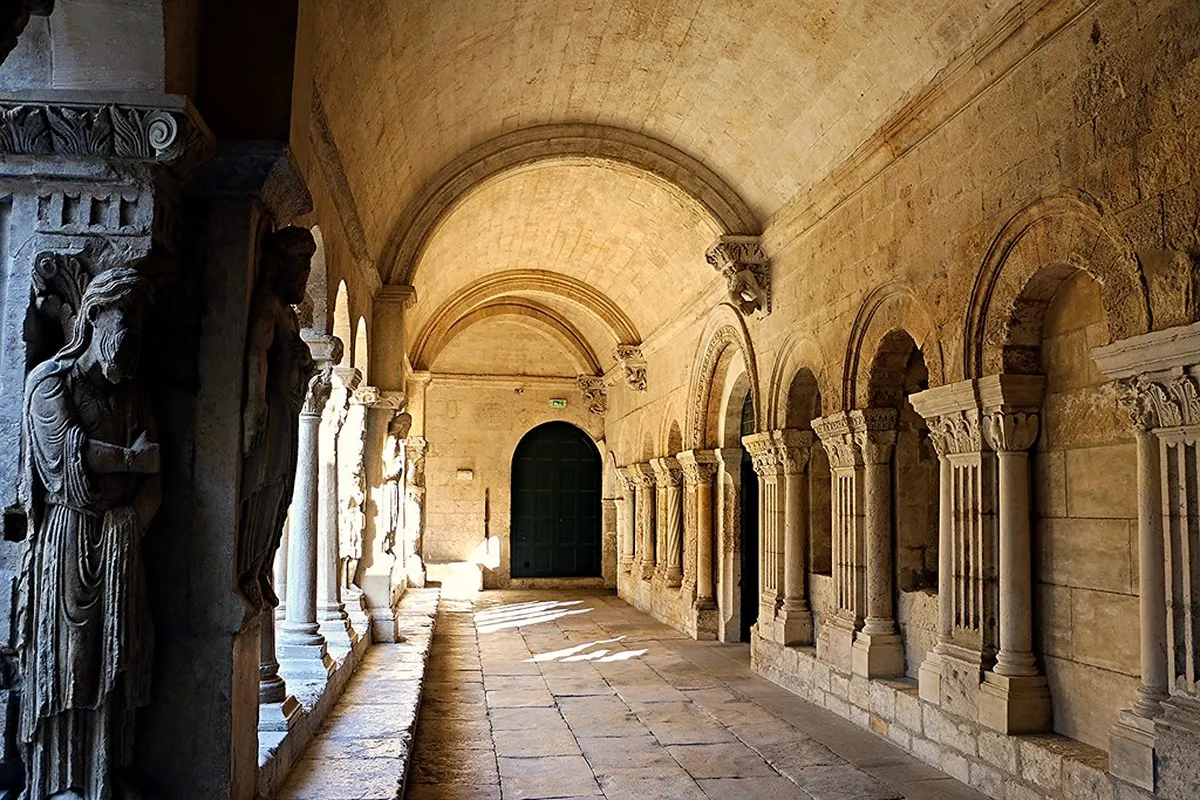
The large corner pillars are the most impressive features of the north gallery. They depict life-sized figures of saints and scenes from the life of Christ. Saint Trophimus himself is shown with great detail on the first large pillar. These statues helped teach religious stories to people who could not read at the time.
The column capitals between the pillars also feature smaller but equally detailed carvings. You can see the Three Kings visiting the baby Jesus on one capital. Another shows the resurrection of Christ with angels standing by the empty tomb. These St Trophime Cloister architectural details offer a window into the medieval religious mind.
The light in the north gallery changes beautifully during the early morning hours. Soft sunlight hits the white limestone and makes the carved figures appear to come alive. Photographers should visit early to capture the deep shadows and highlights on the stone. This section remains the favorite for many students of historic European art.
Transition to Gothic Style in the East Gallery
The east gallery shows a shift in building styles during the late 12th century. It serves as a bridge between the Romanesque and early Gothic architectural periods. You will see that the arches here are slightly more pointed than the north gallery. This change allowed builders to create taller and lighter structures for the canons.
The carvings in the east gallery focus on the life of the Virgin Mary. One famous capital shows the Annunciation where the angel Gabriel visits Mary. The stone figures are slightly more natural and fluid than the earlier Romanesque carvings. This evolution in style is a major part of the architecture in Arles history.
You will also find beautiful floral patterns and leaf designs on several columns. These decorative elements reflect the natural world found in the surrounding Provence countryside. The craftsmen began to move away from purely religious figures toward more organic shapes. This variety makes every pillar in the east gallery unique to the observer.
Walking through this gallery allows you to see how medieval tastes changed over time. The transition is subtle but very clear when you look at the roof vaults. The rib vaults here are more complex than the simple barrel vaults found elsewhere. It is a perfect spot to study the technical growth of medieval engineering.
Exploring the Gothic South and West Galleries
The south and west galleries were completed much later during the fourteenth century. They represent the full Gothic style with sharply pointed arches and slender columns. These sections feel much more open and airy compared to the older galleries. The construction reflects the wealth and power of the church during the late Middle Ages.
The carvings in these newer galleries are often simpler and more repetitive. You will see many geometric shapes and stylized leaves decorating the stone capitals. While they lack the narrative drama of the north gallery, they offer elegant symmetry. This simplicity helps the viewer focus on the overall height and grace of the space.
The west gallery contains several interesting pillars that show local Arlesian saints and martyrs. These figures are carved with a sense of realism that was new for the period. You can see the folds in their clothing and the expressions on their faces. It shows how the St Trophime portal carvings influenced the work inside the cloister.
The courtyard at the center of the galleries provides a wonderful view of the cathedral. From the south gallery, you can see the massive bell tower rising above the roof. The contrast between the delicate cloister arches and the heavy tower is quite striking. This view is especially beautiful during the golden hour just before sunset.
Analyzing St Trophime Cloister Architectural Details
The technical aspects of the stone carving are truly world-class in this cloister. Builders used high-quality limestone from nearby quarries in the Alpilles mountains. This stone is soft enough to carve but hardens over time when exposed. It has allowed the fine details to survive for nearly nine hundred years.
One remarkable detail is the use of classical Roman elements in the carvings. You can find acanthus leaves and fluted columns that look like ancient Roman ruins. The artists in Arles were clearly inspired by the Roman theater and amphitheater nearby. This blend of Roman and medieval styles is unique to the city of Arles.
- Corner Pillars: Features large statues of saints and apostles.
- Double Columns: Provides support while maintaining a light and elegant look.
- Rib Vaults: Shows the advanced engineering of the fourteenth-century builders.
- Cornice Work: Decorative bands that run along the top of the walls.
The layout of the cloister follows a strict square plan around a central garden. This shape represents the four corners of the world in medieval Christian symbolism. Each gallery served a specific purpose for the monks who lived here. Today, it remains a place of quiet reflection for travelers from all over the world.
Planning Your 2025 Visit to the Cloister
The Cloister of Saint Trophime is located next to the main cathedral in Arles. You can enter through the small door in the Place de la République. In 2025, the standard adult ticket price is approximately six euros per person. It is often included in the city's multi-site discovery pass for better value.
The site is open daily from 9:00 AM until 6:00 PM during the summer. Winter hours are usually shorter, so check the official schedule before you arrive. Most visitors spend about one hour exploring the galleries and taking photos. Guided tours are available if you want deeper insight into the stone carvings.
Arles can get very hot during the summer months of July and August. The thick stone walls of the cloister provide a natural and cool escape. Wear comfortable walking shoes because the original medieval stone floors can be quite uneven. Do not forget to bring a camera with a good low-light lens.
The cloister is fully accessible to most visitors, though some areas have small steps. There are informative signs in French and English throughout the four galleries. These signs explain the biblical scenes and the history of the building. It is a peaceful experience that stands in contrast to the busy city outside.
Frequently Asked Questions
What is the best time to see the carvings?
The best time is early morning or late afternoon for soft light. The shadows help the St Trophime Cloister architectural details stand out clearly. Avoid midday when the sun is directly overhead and washes out the stone textures.
How old are the oldest parts of the cloister?
The north gallery was built around the year 1150 in the Romanesque style. It is the oldest and most famous section of the entire building. The other galleries were added slowly over the next two hundred years.
Is the St Trophime Cloister a UNESCO World Heritage site?
Yes, it is part of the Arles, Roman and Romanesque Monuments UNESCO site. It was added to the list in 1981 because of its historic value. This status ensures the site is protected and preserved for future generations.
Can I take professional photos inside the cloister?
Personal photography is allowed and encouraged for all visitors in 2025. However, you must ask for special permission if you use a tripod or commercial gear. Most people find that a standard smartphone takes excellent photos of the stone carvings.
The St Trophime Cloister remains a must-visit destination for anyone interested in European history. Its unique blend of Romanesque and Gothic styles offers a complete visual guide to medieval art. You will leave with a deep appreciation for the skill of ancient stone carvers. Plan your trip to Arles today to see these incredible architectural details in person.
Key Takeaways
- The north gallery features the most famous 12th-century Romanesque statues.
- The east and south galleries show the transition into the Gothic period.
- Limestone from the Alpilles mountains allowed for incredible carving precision.
- The cloister is a UNESCO site located in the heart of Arles.
- Visit during the early morning for the best photographic lighting conditions.
Related reads: architecturebycity.com, provencal romanesque style characteristics, roman architecture in arles.